

The sonic soot blower converts air pressure into sound energy, transfers the energy to the dust, causes the dust to vibrate, and causes the dust to move. This principle is used to remove dust, but the sound dust purifier has different effects in the way of sound generation.
Bagpipe type: An audio adjustable device first developed in my country, but due to its complex structure and equipped with a motor, it has many failures and poor stability.
Hartman siren: due to the diameter installed in the dust space (such as the flue), it will be corroded and worn by the flue gas at any time, and the service life is short; the nozzle is easy to block, due to the use of audio, the sound energy attenuates faster and the radius of action is small , So the number of stations installed in the same situation is very large.
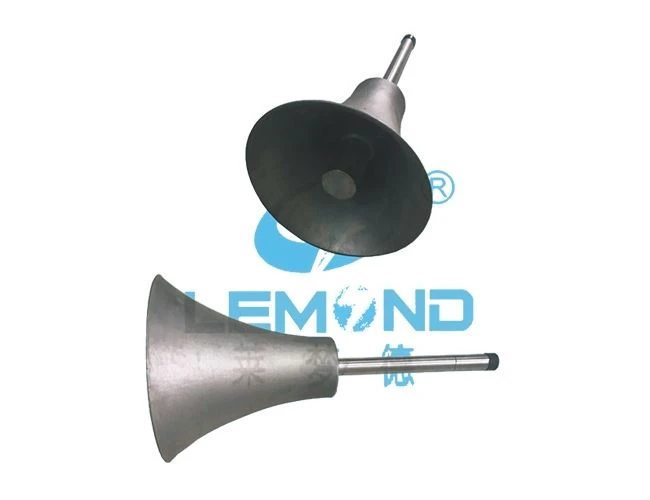
The acoustic dust removers of Kokang Sound Power Company of Sweden and BHA Company of the United States are vibrators. Aiming at the shortcomings of the above two types of acoustic dust removers, with the support of the Chinese Academy of Sciences and based on foreign technology and actual production in China, they have established Energy Conservation and Environmental Protection New Technology Co., Ltd. has developed the ZCK series vibrating plate type acoustic dust remover, which has proved to be more effective than the ikt230/220 imported from Sweden.
The acoustic dust remover is composed of air source, filter, pressure reducing valve, solenoid valve, electronic control unit, sound energy device, resonance simple dust remover, electric dust remover and gray tears. Its core is a sound energy device that can emit low-frequency, high-energy sound waves. So, what is the role of sonic ash remover?
When the sonic soot blower is working normally, the electrostatic precipitator is operating normally, the smoke exhaust is stable, and the electric field and current are stable. Low-frequency sound waves, wavelength, amplitude, slow down (not easily absorbed). The radiation angle of low-frequency sound waves is spherical, 360 degrees, that is, omnidirectional. The sound wave of dust removal is low frequency. In the ash accumulation space (such as boiler flue, heat exchanger, electrostatic precipitator, bag dust removal), a certain intensity of low frequency sound wave is seen, and the sonic soot blower acts on the ash and slag. Can spread in solids, liquids and gases. Like light, reflection, refraction, and electromagnetic waves can be diffracted, and low-frequency reflection and diffraction are strong. These are the physical characteristics of sound waves. When a certain number of cyclic stresses is reached, the ash-slag combination is fatigued and destroyed.


